Academic work
Look for the work products behind discovery
Research careers become easier to compare when you identify the output, its next user and the boundary of responsibility.
Read the article : Look for the work products behind discoveryRESEARCH / WORK / EVIDENCE
Independent academic-work journal
AN INDEPENDENT JOURNAL OF ACADEMIC WORK · ISSUE 01
Behind discovery is a world of careful coordination, specialist services and dependable records. Learn to see that work, read the sources and explain your own contribution.
Independent of UT Southwestern. No employer affiliation, login, credentials or official HR support. Responsible publisher: Tom Wagner.
THREE READING TRAILS
Shared research services, departmental support and application work.
Institution stories, specific vacancies and conditions that still need confirmation.
Safe samples, readable records and bounded evidence of what you can do.
A SMALL RESEARCH INSTRUMENT
Choose a workstream and the level of evidence you have. Get a reading task, a useful output and the question that keeps the conclusion honest.
Fixed editorial guidance. No scoring, eligibility decisions, personal inputs or connection to UTSW.
Use four evidence levels: institution for purpose, function or program for scope, position or applicability for exact conditions, and authorized confirmation for an individual unresolved term. Keep the level attached to the claim.
Sources checked October 1, 2026. Choices stay in page memory; no tool storage, cookies, uploads, URL parameters or network requests. Your browser may restore form state independently.
A SMALL READING HABIT
A benefit overview, a program document and an individual answer have different scopes. Keep the audience and period visible.
Read the document carefully →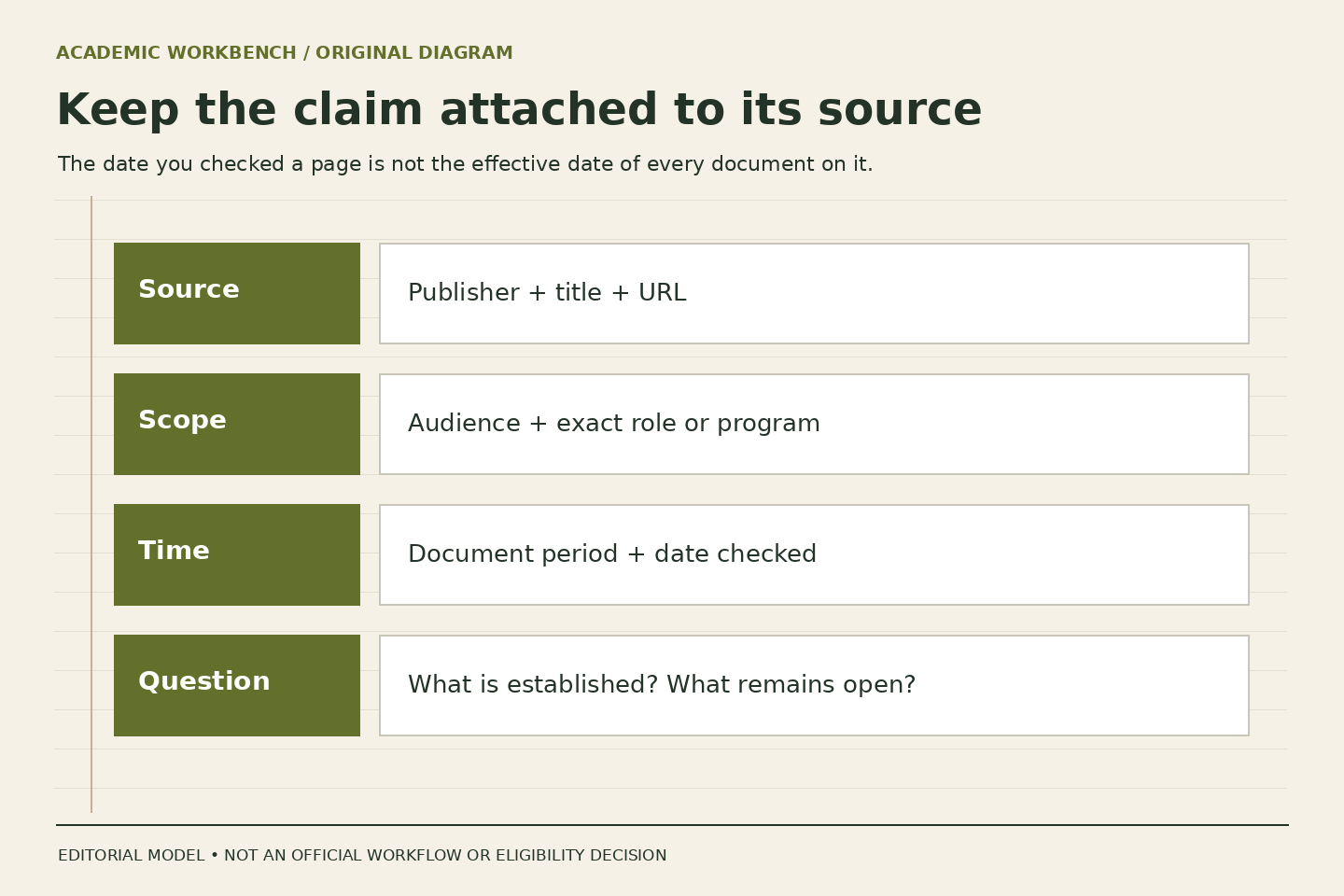
THE READING ROOM
Original explanations, practical exercises and visible source boundaries.
18 articles
Academic work
Research careers become easier to compare when you identify the output, its next user and the boundary of responsibility.
Read the article : Look for the work products behind discoverySource craft
Use four levels of evidence to keep a broad mission, a career family, a specific vacancy and a confirmed term from collapsing together.
Read the article : Move from an institution story to a position you can evaluateAcademic work
A coordination role is easier to understand when you trace inputs, decisions, handoffs and the consequence of an incomplete record.
Read the article : See the dependencies inside academic operationsPractical projects
Explain what you can do with fresh synthetic examples, clear contribution boundaries and evidence you are authorized to share.
Read the article : Build a work-evidence portfolio without carrying workplace recordsAcademic work
Read specialist research-support work through users, capacity, documentation and the boundaries of technical authority.
Read the article : A shared research core is a service relationship as well as a facilityAcademic work
Use the public sponsored-project role map to ask who prepares, who reviews and who has authority at each handoff.
Read the article : Departmental grant support and central administration have different responsibilitiesAcademic work
A product name in a vacancy is only a beginning; identify the service being maintained and the boundaries of authorized change.
Read the article : Read research application work through service, data and changePractical projects
Practise clear agendas, status notes and requests without inventing academic expertise or copying a department’s records.
Read the article : Administrative writing is useful when it carries the next decisionSource craft
Decode the object after the word support before comparing research, administrative and technical positions.
Read the article : Research support does not mean the same thing in every vacancyCareer evidence
A lead, senior or manager title may change breadth, supervision or judgment in different ways; read the scope instead of assuming a universal sequence.
Read the article : Compare responsibility before treating seniority as a ladderCareer evidence
Separate required preparation, preferred evidence and any explicitly stated alternative pathway in the exact vacancy.
Read the article : Read alternative qualification language without granting yourself an exceptionSource craft
A learning benefit is not a general promise to fund every course; keep employee, course and timing conditions separate.
Read the article : Read tuition assistance as a program with conditionsSource craft
A page review date, plan year and future effective date are different facts; label each before comparing benefits information.
Read the article : Put the benefit year next to the claimPublic HR context
Understand the official public reference and separate an employee system from career research, benefits documents and editorial guidance.
Read the article : UTSW PeopleSoft: what the public HR reference establishesCareer evidence
Separate the organizational home, physical setting and stated work arrangement before making a practical comparison.
Read the article : An academic department name is not a complete work locationPractical projects
A small version-aware record is more useful than a folder of unlabeled screenshots when public career and program pages change.
Read the article : Keep a source register that shows what changedPractical projects
A short question brief helps a recruiter or hiring team understand exactly what information would change your next step.
Read the article : Prepare a career question with an object, a source and a consequencePractical projects
Define one skill, one safe artifact and one review criterion before deciding that a course or project will help your career research.
Read the article : Choose a learning project that produces inspectable evidenceAcademic Workbench studies academic operations and career evidence through public UT Southwestern sources. It does not speak for the institution or decide employment, benefit or professional questions.
The collection was prepared with automated assistance. No employee interviews, private-system experience or professional review are claimed.